Skip to searchSkip to main content
Languages

Thierry Maytraud Awards 

The Thierry Maytraud Awards

The Thierry Maytraud Awards aim to recognize urban development projects, planning policy, or cross-sector mobilization strategies that have taken an outstanding or innovative approach to stormwater management.

The organisers of the Novatech international conference are keen to ensure that the conference attracts a wide range of urban policy, planning, architecture and design professionals, who are not necessarily specialists in stormwater management. 

The Awards pay tribute to Thierry Maytraud, urban planner and hydrologist, founder of ATM and partner of Novatech since its creation, who sadly passed away in June 2022.

13 projects selected for Novatech 2026

For this 12th edition of Novatech, 13 projects have been selected by a jury including representatives from the relevant professional disciplines. The shortlisted project leaders are invited to present at Novatech conference day on Wednesday July 1, 2026 to give an oral presentation of their project in front of the jury. The awards will then be presented during a gala evening on the same day.

Are you a finalist project leader?
Download the Novatech PowerPoint template specifically designed to help you prepare your presentation.
Trophy PowerPoint Template
3 categories were proposed:

  • Urban renewal: on public or private land, brownfield rehabilitation, architectural project, neighborhood or precinct
  • Strategies and urban planning: public policy, planning, city or catchment scale strategies
  • Participation and cross-sectoral community engagement: local engagement activities with communities, agencies, private business and urban developers etc.

The approaches we would like to see developed in the presentation of these achievements are multidisciplinary and cross-cutting. They can be presented by several speakers.

They relate in particularly to:
  • The professional organisation, multi-professional and multi-partners, from the design to the social acceptability and the individual’s place in the project
  • The strategies, methodologies developed to join the different aims and objectives of a project, from design to management
  • The ”positive externalities” of the project, its contributions to the environmental quality, the improvement of urban biodiversity and adaptation to climate change.
  • The economic and financial issues 
The jury will take into account the following criteria in selecting the Award winners: 
  • Integration of stormwater management within the project,
  • Use of an integrated sustainable development approach (environment, economy and society) within the overall project,
  • Collaboration, partnership and good governance, 
  • Innovation,
  • Transferability and potential to provide lessons for broader application

Winners will benefit from a publication and a strong promotion of their project in the technical press. 

Discover the finalist projects for the 2026 Thierry Maytraud Awards!
 Regional strategies 

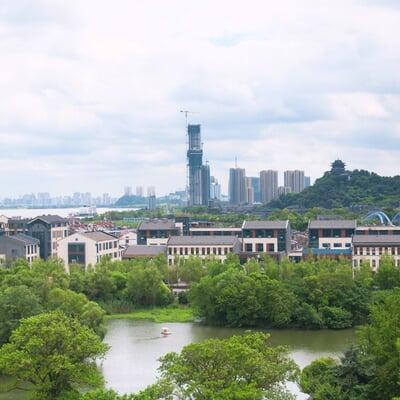
Beyond Theory: Ten‑Year Evidence of Grey–Green Integration for 30‑Year Flood Mitigation and Water Quality Restoration in Zhenjiang / Sun Yat-sen University - China

The Zhenjiang Sponge City pilot (2015–2025) demonstrates a fully integrated green-blue-grey system for climate-resilient urban water management in a dense, 29 km² urban watershed. The project’s systemic approach successfully manages 30-year return period storms (e.g., 256 mm/24 h), has effectively eliminated chronic waterlogging at all 48 historical hotspots, and enhances water quality to China's Class III standard.


> Read the full project summary
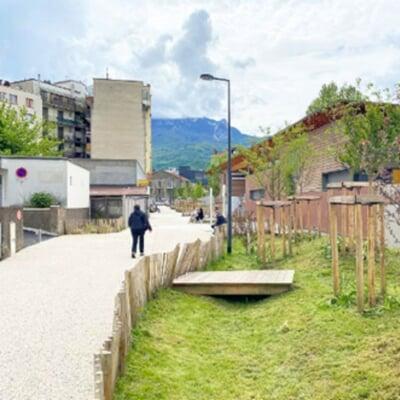
Organizing transversality through the Interdepartmental Circle “Water in the City” of Grenoble-Alpes Métropole Grenoble-Alpes Métropole - France

The shift from 'all-pipe' grey infrastructure urban planning practices to integrated and sustainable stormwater management involves an evolution of professions and the organization of local authorities. To address the many challenges related to this shift, Grenoble-Alpes Métropole has been experimenting since September 2023 with the Interdepartmental Circle “Water in the City”.  Representatives of approximately twenty different departments concerned with integrated stormwater management then participated in various workshops, in order to develop a detailed action plan with follow-up.

> Read the full project summary

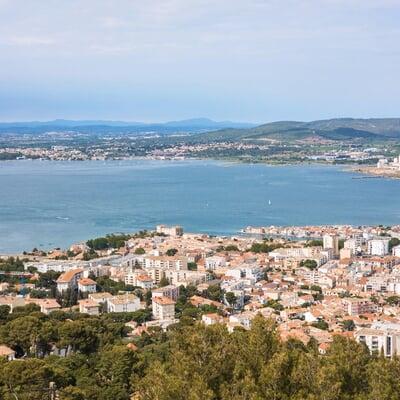
Governance and innovation: Thau’s strategy for sustainable stormwater resilience Sète Agglopôle Méditerranée - France

Faced with growing climate challenges that heighten flooding, coastal erosion, and water quality risks—crucial to Thau’s shellfish-farming economy—the territory has developed a new stormwater management strategy. It builds on two key studies: the Soil Quality Index (SQI), which assesses vulnerability to soil sealing, and the Master Plan for Integrated Stormwater Management (SDGEPI), which maps watersheds, identifies issues, and defines a coherent technical and regulatory framework. 

> Read the full project summary

The “Eau en ville Initiative”: From a paradigm shift to a change in practices Office cantonal de l'eau - Switzerland

The “Eau en ville initiative”, led by the Cantonal Water Office of the Canton of Geneva since 2019, aims to sustainably transform urban water management based on the Sponge City concept. For the past six years, it has driven a genuine shift in practices, with nearly 150 projects supported at various scales. Awareness-raising plays a central role in the initiative, through conferences, publications, and a large media outreach (several thousands of people).


> Read the full project summary

 Multi-stakeholder engagement and support 

Water Facilitator Bruxelles Environnement - Belgium

This free service provides technical expertise to construction and land development professionals, supporting projects at every stage from initial design through to completion. It offers personalized recommendations, an independent perspective to guide decision-making, and the sharing of best practices and field experience, whether for building projects or public space development. Support is provided by phone, email, or directly on-site, depending on the specific needs of each project.

Water management, a challenge for our cities … and opportunity for reinvention Bouygues Immobilier - France

As cities face the growing scarcity of water ressources, and the increasing frequency of climate-related hazards, Bouygues Immobilier has developed a water management strategy in 2025. This strategy is built on two pillars: reducing water consumption, and ensuring sustainable, integrated stormwater management. This latter pillar is based on the implementation of systems aiming at zero runoff from the site during centennial rainfall events. 


> Read the full project summary

Supporting co-owned properties in their greening and rainwater harvesting projects Agence Parisienne du Climat - France

The Paris Climate Agency today incorporates the topic of greening into all of its actions related to the environmental transition of Parisian co-ownerships: raising awareness of issues related to greening and soil de-sealing, engaging the public, coordinating professional sectors, and providing technical support to co-ownerships in their projects. Since the implementation of CoprOasis, the Paris Climate Agency has reached nearly 3,000 people through around fifty events and has advised nearly 500 co-ownerships (representing nearly 30,000 homes) on issues of greening and rainwater management.

> Read the full project summary

 Urban renewal projects 

The Great Pathway: designing a coherent inter-municipal landscape integrating sustainable rainwater management
 
EST Ensemble - France

The « Grand Chemin » (“Great Pathway”) is a 55 kms green loop : 36 kms of this pathway cross the 9 towns of the territorial public establishment « Est Ensemble ». The loop aims to connect numerous parks and green spaces of the Romainville plateau and the Ourcq’s plain. The unique aspect of this project is its integration into the existing urban fabric of these 9 municipalities, under the project management of Est Ensemble, by transforming public spaces into a path going through an “inhabited park” reconciling active transportation, ecological continuities, and the creation of biodiversity areas that can offer coolness and recreation opportunities. 

> Read the full project summary

The Havre City Entrance L'Anton & Associés - France

The project involved upgrading a 2.5km stretch of road with motorway characteristics (50,000 vehicles/day) into a pedestrian-friendly avenue with restructured interchanges (demolition of an interchange and an overpass, removal of small underpasses converted into stormwater storage structures), creation of at-grade intersections, and the development of a promenade and park in place of three gas stations. The 14 hectares of roads, connected to a combined sewer system, were completely separated by the creation of horizontal swales to collect stormwater runoff, small underpasses to store this water, and a rainwater treatment park to purify and reinfiltrate the treated water.

Nouveau Mons Ecodistrict / Water as the source of a new urban and landscape narrative EMP¨REINTE - France

“Le Nouveau Mons” project is proof that landscape is a powerful tool for transforming an urban renewal area. The project completely reversed the proportion of public spaces dedicated to cars, favoring pedestrian and cycle paths and planted areas. Walking in the city has become a genuine pleasure again. Great care was taken with rainwater management: throughout the project, water shapes the design of the public space and supports biodiversity. 


Lyon 3rd District – The Wooded Swale on Rue Duguesclin Indigène Paysages - France

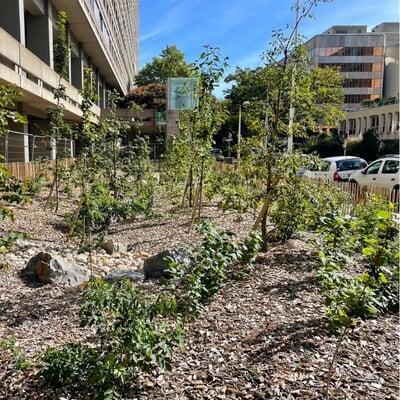
The Rue Duguesclin project (Lyon 3ᵉ) turns a deteriorated green strip into a true piece of urban ecological infrastructure. By separating drainage systems and disconnecting a large share of roof runoff, rainwater is now infiltrated on site through planted swales. This linear wooded system, nearly 150 metres long, creates a cooling effect through shading and evapotranspiration while forming a link in the ecological corridor between Parc de la Tête d’Or and Parc Blandan. Using locally sourced, wildlife-friendly plants, the project creates a resilient and low-maintenance landscape. It continues the modernist legacy of Zumbrunnen and Sillan through a contemporary interpretation of living ground and collective stewardship.

The Rives de la Haute Deûle (RHD) project in Lille-Lomme SORELI - France

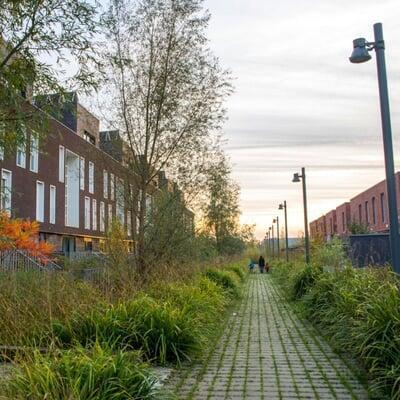
The project, strongly rooted in the historical presence of water on the site, adopted from the outset an integrated approach to stormwater management, backed by high environmental ambitions. Focused on stormwater management, the project has undergone two major phases reflecting this adaptation. The first preserves the memory of the site's industrial heritage and highlights the flow of water on the surface, paving the way for a reinvented urban landscape that reconnects with nature in the city. The second phase is built on the initial experiences gained from this “zero pipe” EcoQuartier and takes environmental considerations even further.

Thriving in a Changing Climate by Celebrating Water as Runoff, Sewage, and Life: Dr. M.S. Swaminathan Eco-wetland Sponge Park in Chennai Sponge Collaborative - France-India

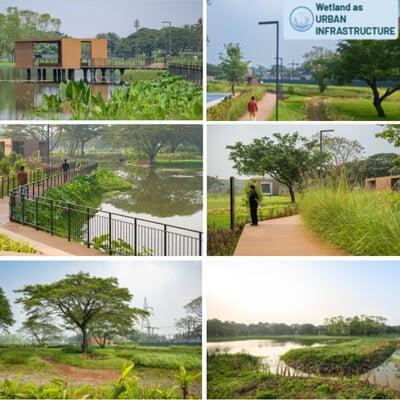
Dr. M.S. Swaminathan Eco Park in the coastal megacity of Chennai is one of India’s largest demonstrations of a Sponge Park as blue-green infrastructure (BGI) for mitigating climate risks of flooding, heat, and water scarcity. The heart of the 16.63 acres project is a restored waterbody receiving treated sewage water. With restoration, the waterbody has become a wetland habitat and flood buffer with 30,000 m3 of storage capacity.

   Some examples of winning projects from 2013 to 2019

Winner of 2016 

Les Mureaux : integrated stormwater management for large-scale, high-quality urban renewal 

(Ville des Mureaux, Bureau d’études INFRA Services - FRANCE) 

This urban renewal project, carried out in the municipality of Les Mureaux (78), covers an extremely dense area of 70 hectares. The project involved the renovation of public and private spaces and the creation of a large landscaped park, within which a watercourse will be brought back into the open. The initial program did not include any rainwater disconnection, but the project manager proposed implementing an integrated management system based on natural infiltration and plot-by-plot management. The creation of a “toolbox” of alternative techniques made it possible to achieve these objectives. By facilitating the choice of techniques and their combinations, alternative management could be adapted to all types of spaces to be redeveloped. 

This approach helped to launch a real environmental dynamic, including the reopening of the Ru d'Orgeval stream in Parc Molière. The quality of the overall project, as well as its stormwater management, was recognized as the work progressed. This resulted in the project being funded by the Seine-Normandy Water Agency for the disconnection of stormwater. The project obtained the Eco-Quartier label, which was not one of the initial objectives. In addition, the Parc Molière project has been certified HQE (High Environmental Quality) for development: this is a first in France.

Winner of 2013 
A "agreement for the future" on runoff water: towards a balanced drainage system
 
(Ulrike Becker, Michael Raaschn, Emschergenossenschaft - GERMANY

The stormwater management system in the Emscher River watershed has been undergoing extensive renovation since the 1990s. As part of this process, the organization responsible for managing the Emscher River and its watershed has been working to implement a large-scale sustainable stormwater management system throughout the entire river basin. The numerous projects that have been carried out demonstrate a great capacity for developing different concepts. 

In 2005, all municipalities in the basin signed the “Agreement for the future for stormwater management,” which has the ambitious goal of improving runoff in the Emscher affluents and minimizing the costs of constructing and maintaining underground drainage infrastructure. They have thus committed to reducing stormwater inflows to wastewater treatment plants by 15% by 2020. To achieve the objectives set out in the agreement, the municipalities concerned are pursuing different strategies.

Winner of 2019 
Blue-green alleys in Montreal: a new paradigme for sustainable stormwater management governance
(Alliance Ruelles Bleues-Vertes, Université de Montréal, Centre d’Écologie urbaine de Montréal, Société d’habitation pour l’est de Montréal, Collectif 7 à nous, Vinci Consultants, Les Ateliers Ublo - CANADA)

Climate change and its impact on communities require a paradigm shift in the way we manage our living environments. The current Canadian governance framework for water management is divided into three levels: the Department of the Environment, which issues Canada-wide standards for municipal wastewater effluent quality; provincial governments, which implement laws and regulations; and local governments, which are responsible for wastewater treatment. 

In metropolitan Montreal, these climate changes are already noticeable, and since the 1960s there has been a marked increase in precipitation. Municipal authorities must therefore plan for the development of new water management infrastructure. Rather than repeating old development models, why not mimic nature? It is in this context that the Blue-Green Alleys Alliance was created to propose the integration of stormwater management into the development of green alleys and a new model for stormwater governance in metropolitan Montreal.